Monthly Archives: November 2013

Taking off: LaunchProgress Empowers the Millennial Generation

by  · November 25, 2013 2:59 PM

I don’t want to put labels on the Millennial generation. With due respect to Generation X, who had plenty of stereotypes and buzzwords attached to them during their youth and coming of age, the evolution of the Millennial generation has come under the microscope more times than any of us care to count.

A plethora of articles have come out, some thoughtful, many condescending profiling the 90 million Americans born, as I was, between 1981 and 2000. Many chart the course of our generation, from home, to school, then right back home with debt, a degree, and no job.

Very few (with some exceptions) note how difficult it is to tease out what makes a generation different, or what shared experiences might shape the mentalities discussed. Certainly, to explain why a generation leans one way or another, we have to isolate factors that stretch across races and languages, and apply to all genders. This is especially true for the most diverse generation in American history.

There are experiences—like growing up during the tech revolution, coming of age in the wake of 9/11 and watching friends and classmates ship out to fight the two wars that followed, or entering the job market in the shadow of the Great Recession—that cut across the cleavages that define Millennial demographics. Bearing a disproportionately high amount of student debt may also fit the bill for what is projected to be the most educated generation in American history.

These shared formative experiences have, if polls are to be believed, led Millennials to adopt radically different attitudes than older generations. From Millennials’ well-documented embrace of equality and civil liberties, to our deep optimism about the future, this is a generation with its own very distinct opinions and ideas.

Gridlock, however, has alienated potential Millennial voters from participating in the public sphere. For the politically minded, it’s no surprise that 55% of Millennials feel that legislators don’t share their priorities while almost half feel that today’s politics can’t handle today’s problems.

This leads many to conclude that Millennials are simply jaded, or unreachable, or self-absorbed. I disagree. I believe that this disaffection will continue until this generation establishes its voice among our national leadership.

Cultivating that representation will take work, and that is why I joined Launch Progress. Together, we can show this generation that not only can their views find a voice in the public debate, but that any one of them can be that voice.

I joined LaunchProgress so that Millennials who want a voice can be a voice, so that the largest generation in American history can contribute meaningfully to the debate over how our shared future forms.

Evan Williamson is a native Illinoisan living and working in Washington, DC.

Election 2013: Where Young People Really Won

by  · November 21, 2013 10:25 AM

Originally published in Huffington Post.

Millennials did it again — we were instrumental in some of 2013’s biggest elections. Whether it was Terry McAuliffe’s success in scaring and sharing “the crazy stuff Ken Cucchinelli said,” Bill de Blasio’s ability to turn out Brooklyn hipsters, or Chris Christie’s straight talk, young voters turned out in droves. Politicians love us — or if they don’t, they at least fake it until they make it. I suppose this means young people are gaining ground.

But where no one was watching, young people had even bigger wins this year — as candidates.

P.G. Sittenfeld, Cincinnati’s youngest city council member, won re-election in his race this month. He received 10,000 more votes than any other winning council candidate. Thirty-year-old Antonio Reynoso, a born and bred Brooklynite, won a New York City council seat by defeating the old Democratic Party machine. Boone, North Carolina, elected community organizer Andy Ball, who at age 30 will be the city’s youngest mayor. Young Americans across the country, representing the latest Millennial trend to bring bold leadership to government, ran and won this year.

Young people are running for office everywhere. They’re not waiting for older candidates to get Twitter-trained, and they’re not waiting for political parties to craft the perfect messaging for young voters. This smart, connected, solutions-oriented generation is jumping into politics head first and running for office on the local, statewide, and national issues they care about. Take for instance, Montravias King, a senior at Elizabeth City State University. A local GOP chairman challenged King’s candidacy for city council, claiming he wasn’t able to run for office because he lived in a dorm. King fought back, earned his right to run, and won his council seat in Elizabeth City, North Carolina, campaigning against the state’s controversial voter ID law.

Young people in the past tended to have smaller networks, limited public speaking experience, and were less politically engaged. But this generation of young people can easily create large networks through social media and connect to hundreds of leadership training programs conducted by now-seasoned campaign staff and youth engagement experts. Maybe most importantly, we are self-motivated to run for office. Millennials see an opportunity and we seize it. We see a problem and we solve it. We see a need and we fill it.

The 2008 presidential election brought the youth vote into the mainstream. Five years later, we are seeing a marked shift — another unique opportunity — young electeds. If political parties want to keep young voters engaged, if progressives and tea partiers want to create lasting change, they should follow the lead of this year’s young elected officials and run young candidates. They represent real wins for young people.

The LaunchProgress Story

by  · November 18, 2013 9:35 PM

It started with a familiar scene: two good friends sitting around a kitchen table drinking a couple of beers.

In this story, these two good friends—Luke and I—grew up using email before we learned our multiplication tables. We have always been hyper-connected to our peers through instant messaging, texting, Myspace, Facebook, Twitter—the world has always been infinite and at our fingertips. But it’s also the story of two friends who came into political awareness in the age of President George W. Bush and came into political maturity in the age of President Obama. We are two friends who entered the workforce during one of the country’s worst recessions, which brought on an economic crisis but also opened up deep cultural wounds, dividing us by race, class, gender, sexuality, and region.

This is a familiar story of any two young Americans today. We are empowered by technology, hardened by the whiplash of political extremes, and moved by the struggles and perseverance of our neighbors, our peers, our families.

But the LaunchProgress story goes on with an opportunity.

First, we saw a problem: Young people were asked to participate in the political process and after we contributed energy and ideas, we were asked to wait in line—to be patient. Young progressives, once energized by politics, became jaded by political gridlock and beaten by an unrelenting economic recession.

Then we saw a solution: Re-engage young progressives by asking them to run for office. Encourage them to contribute their fresh perspective and new ideas the country desperately needs. Help them put their energy toward representing people how they want to be represented.

And there was the opportunity: We spent months talking to friends, family, past and future candidates, young activists, community members, academics, researchers, lawyers. After six months of research we believed it could be done, it should be done, and if no one else was going to do it, we would step up to engage, encourage, and help young progressives get elected to their first state or local office.

LaunchProgress is in its infancy. We’re still building the structures. We’re still drafting the documents. We’re still making mistakes and learning lessons. But the original problem we saw persists, the solution is still possible, and the opportunity to engage young Americans and build the bench for the next generation of national progressive leaders is real.

The LaunchProgress story is a familiar one. There is no secrecy nor espionage nor million-dollar adventure. It’s a story of opportunity. It’s a story of two friends who, like many young Americans, are committed to our peers, our families, and to public service. And it’s a story that’s still being crafted. Luke and I started LaunchProgress, but it will be up to our supporters and volunteers to help shape it, to energize it, to push it forward. Because that’s what progress is—and we are really looking forward to it.

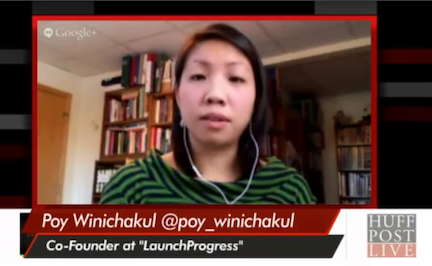
Pichaya Poy Winichakul is a Co-Founder and Co-Director of LaunchProgress. She is proud of her progressive Wisconsin roots and is an equally proud resident of Brooklyn, New York.

Why I Joined LaunchProgress

by  · November 12, 2013 10:40 PM

In May 2008, then-presidential candidate, Barack Obama, filling in for Ted Kennedy, made an unscheduled campaign stop to deliver Wesleyan University’s commencement address.

His speech called on the red and black sea of graduating seniors to follow the Kennedy’s legacy and ask what they could do to serve their country.

I was only a freshman, but for the first time in my life, I felt like a politician actually got me. Here was a guy running for office who was unabashedly intellectual, pragmatic, and moral. He was multiracial, eschewed party labels, and he was younger than my parents. This wasn’t empty rhetoric – this was change I could believe in. And what’s more, he believed in us.

As millennials, that’s not easy to find. Too often, we’re dismissed as entitled, lazy, and too reticent to become productive citizens. And with so much political dysfunction and gridlock in Washington, it’s tempting to live up to the stereotypes: to give up on real progress, and by extension, ourselves.

That’s where LaunchProgress comes in: a nonprofit dedicated to identifying future leaders and helping them along the way. And there’s strength in numbers: Twenty-somethings represented under one-fourth of eligible voters in 2012; in 2016, we’ll reach 30%, and by 2020, we’ll rise to 36% of the electorate.

I’ll admit, we twenty-somethings still have a long way to go– but so does this country. So instead of abandoning all the “hopey, changey” stuff of 2008, I joined LaunchProgress.

I hope you will, too.

Jae Aron is an Account Assistant at GMMB. She currently lives in Washington, DC.

Barack Obama at Wesleyan Commencement Ceremony

LaunchProgress Will Invigorate the Millennial Vote

by  · November 07, 2013 12:29 AM

While the 1996 presidential election dominated the media, I was a waifish 7 year old trying desperately to organize a mock election in my elementary school. Shockingly enough, the 5 to 10 year old set isn’t very politically active.  Besides some quizzical looks at the two greasy cardboard boxes and a folding chair in the corner of the cafegymatorium, my campaigning attempts went completely unnoticed.

In the years since, I have only grown more politically wonkish, though the fruitfulness of my attempts remain questionable. No matter how many well-crafted puns I Sharpie onto protest signs, or how many bar patrons I bother with the varied argumentations for minor party ballot access, it is impossible to gain any political influence without representation in elections.

My generation of Millennials was raised on the notion of voting for the lesser of two evils.  We vote for Kerry because “at least he’s not Bush,” Obama because “at least he’s not Romney,” McAuliffe because “at least he’s not Cuccinelli.”  We’ve grown so jaded and cynical in just a few election cycles.  If we don’t get some invigorating candidates soon, who actually represent our values and perspectives, our generation will be lost to political apathy.

That’s where LaunchProgress comes in.  While establishment candidates ride waves of disingenuous campaign slogans, and a gridlocked Congress does nothing to address America’s needs, 22 million young Americans are ignored, LaunchProgress is changing that by empowering young progressives to take the next step in public service—to run for office. Their goal is to identify youth leaders who represent our changing, diverse America—women, people of color, people from lower-income families, people who are disabled—and connect them to unique professional development resources.

Our generation is the future of this nation, and it is time to fight for a say in the policies that will shape America.  With LaunchProgress’ help, our candidates have a chance to fight for us—the next generation of America’s leaders–in local, state and federal office.

Megan Marjan Ramsey is the Marketing Coordinator at FiveFortySix. She is a LaunchProgress supporter and volunteer, and an avid political news junkie. She currently lives in Alexandria, VA. @MarjanRamsey