Author Archives: admin

Young Candidate Spotlight: Emily Weinstock-Collins

by  · March 30, 2015 9:50 AM

Spotlight: Emily Weinstock-CollinsThis month’s Young Candidate Spotlight features Emily Weinstock-Collins, who is running for office in Martic Township, Pennsylvania.

What office are you running for?

I am running for office in Martic Township, PA. Our community is looking to establish Home Rule as our system of local governance, and I am running for the Government Study Commission that will determine whether Martic Township ought to pursue Home Rule and, if so, will draft the Home Rule Charter to be placed on November’s ballot.

What motivated you to enter politics/public service?

Last March, I found out that Williams Company is planning to put a major natural gas transmission pipeline through my backyard. Most of this gas is contracted for export, yet—if approved—the project would trump resistant landowners through eminent domain. Many of our friends and neighbors received similar information, and we formed a concerned citizens group. We are now a PA non-profit called Martic SOUL (Save Our Unspoiled Land) working to prevent this and other harmful industrial projects in our area. Having tried many different angles, including working with our Board of Supervisors and with the Federal Energy Regulatory Commission (FERC), we have found that Home Rule is our township’s best and possibly only way to stop the pipeline and protect our community.

Why are you running for Government Study Commissioner?

I am running for this position because I believe Home Rule is the right step for our community. Short term issues aside, Home Rule both gives the people of Martic more say in their local government and gives us the opportunity to craft a township charter that addresses the unique needs of our rural community. Through initiative, referendum, and recall, each voter will have a direct impact on the decisions of our township. This system will ensure that the local government reflects the will of the people, and will prevent outside interests from trampling local needs. I am also committed to opposing and finding alternatives to the environmentally devastating expansion of dead-end fossil fuels like fracked natural gas. If our state and federal governments won’t take the leadership in moving us towards a sustainable energy future, local communities will have to take the lead. I care deeply about the future of our community, and I hope to help shape and protect that future by serving on the Government Study Commission.

What are the most pressing issues in your district?

As mentioned above, the pipeline is the most immediate issue in Martic Township. However, the pipeline has revealed a larger
underlying issue in the current structure of our government; it has demonstrated that our local government, under its current 2ndClass Township status, is not able to protect the Martic residents from harmful corporate invasions such as a pipeline. Under Home Rule, we would be better able to secure our rights and preserve our community, our homes, our farmlands and forests, our Native American heritage sites, and the unique, rural lifestyle of Southern Lancaster County. We also hope, through Home Rule, to better protect the interests of our large Amish population, whose voices—largely in opposition to this proposed industrial invasion—have been almost entirely ignored precisely because the current system is able to utterly disregard their interests. I believe the first and foremost purpose of government is to protect the safety and rights of its people, and so I believe that adopting Home Rule is an essential step for our township.

What were some of the obstacles you’ve had to overcome in your political career?

I am running for the Government Study Commission with a slate of six other candidates connected with Martic SOUL. The main obstacle we have encountered is a lack of accurate information available to the public. Martic SOUL has worked hard to research and find the facts, and the main focus of our campaign has been to share this important information with our community. However, we have also found that misinformation—about the pipeline and Home Rule—is being spread by the pipeline company and other opposition both within and outside the township. This tactic has made our work significantly more difficult, but we hope to continue educating our neighbors so that our community can make an informed decision on this issue in May.

How is millennial leadership important to you?

The millennial generation is the generation of the future – but that does not mean that we should wait to participate in our communities until that future arrives. We need to help shape and safeguard that future starting right now. Home Rule is especially important in that sense, because it gives all Martic residents a direct say in the decisions of our township. It allows not only young people, but all generations to help shape the future of their own community. As a young voter and active citizen, it is very exciting and empowering to see not just Martic, but municipalities across Pennsylvania and the U.S. joining the movement to assert community rights through Home Rule.

Are there any words of wisdom that you would like to impart to other young people under 35 considering running for office?

I can’t emphasize enough the importance of educating yourself and your community. In order to make an impact, it is essential to have all of the relevant and accurate information around the issue you are addressing.

Additionally, I see a lot of my peers disengaging from politics because they are disillusioned with the political system and convinced they cannot make a difference. But you absolutely can make a difference! With passion and dedicated hard work, you will be surprised how much you can accomplish for your community.


You can learn more about Martic SOUL and the issues they are working on by visiting their website.
Women’s History Month

by  · March 23, 2015 1:06 PM

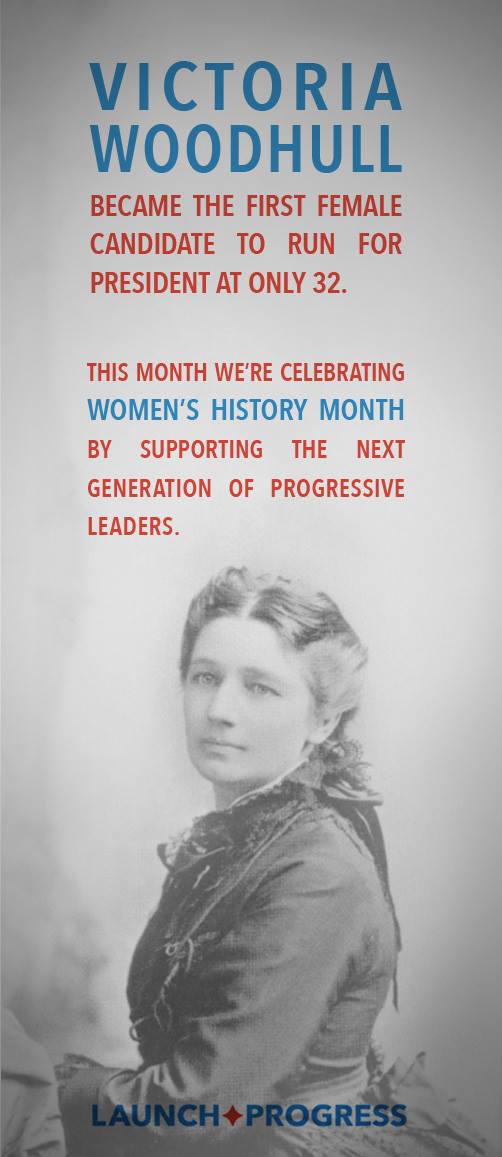
Womens History Month: Victoria WoodhullMarch is Women’s History Month. While we take stock of the many accomplishments of women in history, it is an important opportunity to assess where we are in 2015, and to recognize how far we still have to go to establish true gender equality.

Consider the case of Emma Sulkowicz, who has garnered national attention for her public stand against Columbia University’s unwillingness to take disciplinary action against her accused rapist, fellow student Paul Nungesser. Each day Nungesser goes unpunished, Sulkowicz carries her mattress around campus. As a result, Sulkowicz has been subject to vicious public attacks against her character that reach deep into her private life.

But the latest volley came from a recent Daily Beast article on Nungesser — who was accused of raping three other young women and a young man while at school. Reading the piece, I was shocked to see Sulkowicz’s private Facebook correspondence published as evidence in an attempt to exonerate him, a glaring transgression of her privacy.

Sulkowicz’s case highlights our society’s inability to talk about providing women with security and autonomy in their private lives — be it in the bedroom or the doctor’s office — while protecting the sanctity of their privacy. Her performance art project captures perfectly this collapse of the private into the public. As she carries the symbol of the most intimate of spaces in public view, the world is given almost voyeuristic access to both the site of her attack, and the vulnerability she feels as her safety and privacy are denied.

This case also demonstrates the profound flaws in our conversations and policies on topics relating to women. But to make real change, we first need more women in leadership roles who can change the conversation.

Decisions about the private sphere for women are currently decided in public discourse dominated by men. As our legislative bodies take up issues like reproductive choice and sexual safety, too few women are even present to help make these critical decisions. There are only 104 women in Congress, or roughly 19 percent. In state legislatures, where much of this policy is made, it’s only slightly better at 24 percent. Ruth Bader Ginsburg recently recounted a common question asked of her by interviewers regarding when there will be enough women on the Supreme Court. She lamented the shock that many have when she replies, “When there are nine.” We must demand more.

But we must also ensure that legislative chambers are places that are hospitable to women. As a scathing Politico report on the history of women in the Senate recently demonstrated, these spaces are often dismissive of, and sometimes outwardly hostile toward, their female members. The public sphere must be a place where women are respected and listened to. The exercise of real autonomy in this country should not be gendered, and we must stop demanding the public sacrifice of women who seek to exercise that autonomy.

This is why I support the work of LaunchProgress, an organization that targets the discrepancies between our elected bodies and the general population. It aims to bring more young people from diverse backgrounds into public office, so that public discourse and policy can reflect the multitude of voices that make up the American populace.

We desperately need more women, more people of color, and more young people in leadership positions so that the future of our country serves average people rather than the powerful few. LaunchProgress understands that this begins locally, at the state and municipal level. By focusing on building the bench with young progressives, including more women, LaunchProgress is laying the foundation for these leaders to go on to influence national conversations.

Securing a more just future for this country requires taking a critical look at the abysmal state of diversity in national leadership. So this month, let’s not just remember the greatness of past accomplishments, but remind ourselves how far we have to go.

Young Candidate Spotlight: Andrea Campbell

by  · February 25, 2015 3:34 PM

Spotlight: Andrea CampbellThis month’s Young Candidate Spotlight features Andrea Campbell, a Boston native who is running for Boston City Council District 4 this year. I had the chance to talk to Andrea and learn a little bit more about her background and her campaign through our Q&A session.

You have a background in Law, what motivated you to make the switch over to politics?

I served as Deputy Legal Counsel for Governor Patrick, who inspired me to pursue public service. I was in a unique position and in an incredible space to observe him in action as a Governor. I was exposed to his values and opinions about the importance of young people being engaged and active in politics, and in particular, candidates of color being in engaged in politics and active in their community. I see politics as one way to give back to my community.

The person who empowered me to run for office is my older brother, who was recently released from prison, and who candidly said to me after a discussion with him about what was next for me in terms of my profession, “Sis, why don’t you run for office? You have such an incredible story, you’re clearly qualified” and “Our kids need you.” It was the first time that I actually sat still for a minute and thought, “Why don’t I think about running for politics to give back to a community that has given me so much?”

I ultimately made the choice after hearing a sermon that said something to the effect of “If you don’t know what your passion is, that’s okay,” and “If you feel like a lot of people are telling you the same thing, that’s probably it, just take the first step.” After that, I decided to take that first step in running for office.

What attracted you to run for City Council?

For me, it is the best way to interact with your neighbors and your community directly. It is a space where you can have an immediate impact on those people, and you know exactly whom you are reaching. Right now I’m doing what I call a listening series, where I’m going around and having one-on-ones with people who live and work in the district. There’s such power in having those intimate connections. You can’t get that at the Federal level, or even at the state level. As a City Councillor, you get to be the conduit between your neighborhood and City Hall.

What are the most pressing issues in your district?

One of the biggest issues in the country, but especially in District 4, is civic and voter engagement, you know, how do we turn out more people to vote and to get them to become more engaged in their communities? Another important issue is access to quality schools. Some schools are doing very well, and some have been marked as failing. We have to look at different solutions to this problem, such as breaking down barriers to access, supporting early education programs, and improving failing schools. Some of the other issues in the district include economics disparity, access to capital and entrepreneurial opportunities, and violence and trauma. We have to start looking at creative ways to address these issues.

What are some of the biggest obstacles that you’ve had to overcome in your political career?

One of the biggest barriers that I’ve encountered is the notion that black people shouldn’t challenge other black people in politics. It has been hard to transcend this idea of identity politics, and to get people to understand that I’m not a black person trying to take out another black person, but rather a qualified person who is running against a sitting incumbent in order to bring a fresh perspective and new ideas to address both old and new challenges.

Another challenge I’ve encountered is being a young leader. On the one hand, senior citizens are proud to see one of their own be successful and run for office, but sometimes they feel that young people can’t understand what they’ve been through. I understand the importance of listening to their struggle and heeding their wisdom.

How important is millennial leadership to you?

I wholeheartedly believe that young leadership can increase civic engagement. Young people sporadically turn out to vote, and I have found that when a young person can engage with another young person, it re-energizes them and gives them a reason to show up at the polls because they feel that their issues are understood.  Just listening and paying attention is a big deal to young people.

Are there any words of wisdom that you would like to impart to other young people under 35 considering running for office?

If you feel it in your spirit, and people keep telling you to go ahead and do it, just do it! Take that first step, don’t wait, and there’s “Never a right time.”

Young Elected Official Spotlight: Ohio State Representative Dan Ramos

by  · January 29, 2015 1:58 PM

Welcome to our ongoing interview series highlighting young elected officials and young candidates. This month we spoke with Ohio State Representative Dan Ramos, who represents Ohio’s 56th House District, which covers western Lorain County. Representative Ramos also currently serves as the Chair of the LaunchProgress Action Fund Board of Directors.

Representative Ramos was first elected in 2010. He is a Lorain native and was the first Hispanic Representative of either caucus in either the House or Senate to serve in a leadership position, serving as Assistant Minority Whip. Representative Ramos says he has always been interested in politics, governance, and government. His interest led him to volunteer for campaigns in his free time and work at the State Legislature, as a Legislative Aide and as a Senior Policy and Budget Analyst, before making a run for office himself.

His boss at the time, who previously represented his current district was reaching their term limit. Running for office to fill the seat “felt like the right thing to do,” he said. “There are things that need to be changed and worked on like college affordability, access to health care. I wanted to work with others to make a real difference.”

Running for office, especially the first time, wasn’t easy. He recalls wanting to meet everybody, “but the legislative district is over 100,000 people. That’s just physically a lot of people to meet.” He spoke about learning to be comfortable in his own skin. He mentioned past experiences working with legislators and candidates, but “being the person in front is different than being the person behind the scenes.”

Now, as a legislator, Representative Ramos is working to bring jobs back to his district and finding ways to re-train people to get new jobs. He is also focusing on making college affordable. “The two issues go hand in hand,” he said. He explained that more jobs now require a college education. If college is not affordable, many people cannot get the education the need to get a job. He also challenged that the extreme cost of higher education is also hindering college-educated people from fully participating in our economy. “If you go $50,000 or $100,000 in debt to go to college, you’re spending the next ten years paying just for that, and you’re not really able to contribute to our economy in other ways.”

As a young elected official, Representative Ramos continues to uplift the voices of other young people because “we bring perspective of the truth right now.” For example, on issues of college affordability he explained, “it’s important to show folks it’s not the way it used to be. It’s not where you can work two months in a mill and raise enough money to send yourself to college. That’s impossible now.” He also said younger people have a unique perspective on other issues like global climate change. Young people can look at this issue differently simply because “we’re planning to build a life here that lasts many decades.”

In talking about young people getting involved in politics and public service, especially in running for office, Representative Ramos advised young people to get to know their city councilmembers, state legislators, and local electeds. “Many of my colleagues are eager to have younger folks involved so they can bring their experiences, bring their leadership, bring their ideas to help us out.”

And just by getting involved and getting to know your legislators, you can have a better idea of what it’s like to run for office and be in office. That’s how he got to where he is today. “This was supposed to be something that I did an hour or two of my time a week when I had it, and it turned into every minute of every day because I fell in love with it.”

To learn more about Representative Ramos, check out his bio here. Get more involved in public service and governance, as Representative Ramos suggests, including opportunities to interact with more young elected officials by joining the LaunchProgress Action Fund listserv.

Changing Political Apathy Into Enthusiasm

by  · January 28, 2015 3:50 PM

My name is Jack and I’m a senior at Fordham University who is studying International Political Economy. My favorite things to do are traveling, cooking, trying weird foods, and watching too many movies.  All fun aside, I have always been interested in policy change as a means by which our government can better the lives of its citizens. I believe that by bringing the fresh voices of younger elected officials into the political discussion, we might inspire positive change in our community.

Too often I hear comments from my peers along the lines of “Nah, I’m not going to vote, both candidates are terrible” or “Who cares? Our government can’t get anything done anyway.”  It’s hard to blame them; often, middle-aged male politicians just aren’t passionate enough about issues that matter to us or don’t care about the needs of our generation, and those would-be voters simply tune out.  I believe that there is a way to change this political apathy into enthusiasm.

I joined LaunchProgress because I want to be part of an organization that is eager to change the often toxic attitude of my peers by bringing more discussion from my generation into politics, and bringing youthful leaders into office to represent the voices that often go unheard in the political world.  I want my friends and colleagues to care about which politicians are representing them in office. After all, it is our generation’s future that is at stake.

Leadership to Implement Immigration Reform

by  · December 11, 2014 4:25 PM

Our greatest achievements have been built by those families who came here to work for better lives — families who have gone on to lead our nation in various capacities. We must ensure that our political representatives at every level, from the executive down, are committed to acting on this chance to demonstrate tolerance and fairness.

President Obama made a historic announcement last month about what is sure to be one of the defining issues of his presidency: Using an executive action, he pledged broad immigration reform, offering legal status to undocumented immigrants who meet certain criteria. Adults who have been in the country for five years, have children who are citizens or legal residents, and who can pass a criminal background check will be granted temporary security from deportation. This action will prevent about 5 million immigrants from being deported, enabling families to stay together and for these individuals to “come out of the shadows”’ and work with full legal protections.

This sweeping action was met immediately with both great fanfare and critique. Many argue the president’s action is a common sense, long overdue expansion of his prosecutorial discretion. They claim Obama’s move echoes those taken by many earlier presidents of both parties. His critics insist this broad use of executive power knows no precedent, and it sets a dangerous standard for years to come. They also maintain Congress is the proper domain for such wide-reaching immigration reform, and the president’s action is a flagrant affront to legislative authority. Still others say he did not go far enough, as Obama’s plan offers no clear path to citizenship.

Political debate aside, it is evident this move will provide long-awaited relief to hardworking families who have contributed to the economic and cultural strength of this country for too long without legal recognition. It demonstrates to everybody — young or old, citizen or not — that America is a country of integrity that legally acknowledges those who contribute. By offering security to those most vulnerable populations who have risked so much to provide for their families and add to our country’s prosperity, this action demonstrates our capacity for both justice and compassion.

Furthermore, it will provide stability to children with undocumented parents who deserve to attend school and realize their future ambitions without the constant fear and anxiety of needless family division. It shows these children that, as they invest in building their futures in America, we are also investing in them.

President Obama’s action is also an acknowledgment that the American electorate is rapidly changing, and these issues are increasingly important to a large portion of the population. Many Americans are now personally touched by immigration issues. For instance, some 64 percent of Latino voters have a friend, coworker, or family member who is undocumented. With greater diversity comes greater legal responsibility to actively recognize all people, and not only those who have traditionally maintained power.

However, political leadership comes nowhere near representing the diversity of this nation. This lack of diversity creates a disconnect between elected officials and their electorate, which makes it exceedingly difficult to pass thoughtful legislation on this topic. Although Obama’s action may bypass Congress, it does so to forge a more inclusive democracy and increase civic trust. Civic trust begets greater participation. And as participation expands, our government will hear and be made up of more diverse voices.

This is where LaunchProgress hopes to make a difference. By empowering young people of diverse backgrounds to run for office, we hope to create legislative bodies that have a multitude of perspectives to truly represent and understand the issues of everybody in this country, including immigrants. By getting more people into local office who support these goals, we can begin to fund programs to reform the immigration system from the inside out.

For example, much of the implementation of President Obama’s plan will rely upon local legal and immigration advocates to guide millions of people through the intricate paperwork involved with this process. These advocates are frequently vastly underfunded by local governments. Without adequate resources, they are unable to meet demand. The support of politicians at the municipal and state levels can make all the difference in ensuring that anybody who is eligible can take full advantage of this opportunity. Thus backing progressive candidates who understand the critical need for support of immigration services on the ground is essential. These are the types of local leaders LaunchProgress seeks out.

We are at an important juncture as a country. As demographics shift, so too must our policies. President Obama’s action looks back to our historic strengths as a nation of immigrants, and realizes the tremendous potential that inclusive policies can bring us in the future. Our greatest achievements have been built by those families who came here to work for better lives — families who have gone on to lead our nation in various capacities. We must ensure that our political representatives at every level, from the executive down, are committed to acting on this chance to demonstrate tolerance and fairness. And who knows, we may see some of these young Americans’ names on the ballot in a few years.

Electionpalooza—The States to Watch

by  · November 03, 2014 1:54 PM

This election we keep hearing one thing about the campaigns, “Who will control the United States Senate?” That’s an exciting question, but it’s not the only one I care about. As a progressive, I care about healthcare access, voting rights, environmental protections, education, economic mobility, and LGBTQ rights. That’s why I care about what is happening in the state chambers across our country.

And that is also why this election is so critical. As John Oliver recently commented, “State houses do a huge amount of work while no one is watching.”

In the United States, there are 49 state houses (Nebraska has a unicameral body, so it doesn’t have a State House) that represent 5,413 state representatives, and 50 state senates that comprise 1,972 state senators.

Why does this election matter? The majority of these 7,385 seats are up for election. Every state in the country has an election on Tuesday, most for critical office seats and many where the partisan control of the state government will be determined.

State Chambers by the Numbers

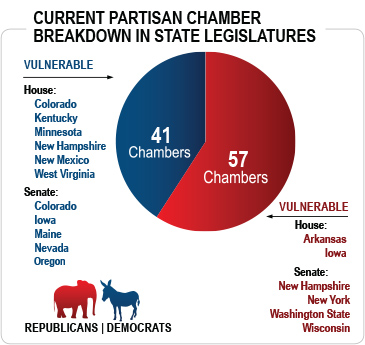
58 chambers, 29 state senates and 29 state houses, are under Republican control. Democrats have majorities in 40 chambers, 20 state senates and 20 state houses. (Source: Ballotpedia)

On Tuesday, 87 of the 99 chambers will hold elections. These 87 chambers will be determined by the results of the 6,057 (or 6,049 according to the NCSL) elections that will be held for the candidates vying for state senate and state representative.

Current Partisan Chamber Breakdown in State Legislatures

Graphic courtesy of National Council of State Legislatures

And Don’t Forget the Governors

On the executive side, 36 state governments have gubernatorial elections. 22 of these races are for offices currently held by Republican governors. For many of them, this is their first re-election bid since the Tea Party wave of 2010. 29 of these elections have an incumbent running for re-election.

Most research suggests that probably 9 of these races are potentials for partisan switch—Arizona (Jan Brewer—R, is retiring); Arkansan (Mike Beebe—D, is termed out); Connecticut (Dan Malloy—D, is running for re-election); Florida (Rick Scott—R, is running for re-election); Georgia (Nathan Deal—R, is running for re-election); Illinois (Pat Quinn—D, is running for re-election); Kansas (Sam Brownback—R, is running for re-election); Maine (Paul LePage—R, is running for re-election); Pennsylvania (Tom Corbett—R, is running for reelection).  Keep an eye on these states, but be ready for surprise upsets in other places.

States to Watch

With 87 chambers holding elections, there is a lot of turmoil at the state level. Some of these races are incredibly close. For instance, the partisan control of Washington State’s Senate chamber is determined by just 1 person. In the Colorado and Nevada State Senates, party control is also determined by just one vote. In fact, there are 15 legislative bodies where the partisan control is currently determined by less than 10% of the total members. Voters this cycle have the potential to change the direction for a lot of state governments.

There are so many close races, but to narrow your focus, Ballotpedia compiled a Top 20 Elections to Watch.

  • Arizona Senate (Republicans currently control 17-13)
  • Arkansas House (Republicans control 51-48, 1 member is in the Green Party)
  • Colorado Senate (Democrats control 18-17)
  • Iowa Senate and House (Democrats control Senate 26-24; Republicans control House 53-47)
  • Kentucky House (Democrats control 54-46)
  • Maine Senate (Democrats control 19-15, 1 member is an independent)
  • Michigan House (Republicans control 59-50, 1 member is an independent)
  • Minnesota House (Democrats control 73-61)
  • Nevada Senate (Democrats control 11-10)
  • New Hampshire Senate and House (Republicans control Senate 12-11; Democrats control House 213-173)
  • New Mexico House (Democrats control 37-33)
  • New York Senate (Democrats control 32-29)
  • Oregon Senate (Democrats control 16-14)
  • Pennsylvania Senate and House (Republicans control Senate 27-23; Republicans control House 111-91)
  • Washington Senate (Democrats control 25-24)
  • West Virginia House (Democrats control 53-47)
  • Wisconsin Senate (Republicans control 17-15)

Follow the Action

Which parties will gain control? What will our youth turnout look like after so much attention has been paid to Millennials? How many states will retain their partisanship? How many new voters may be denied voting because of new voting restrictions? I’ll be looking for these answers and more come Tuesday.

For real time updates on the 6,057 elections that will determine the partisan control of the 87 state chambers  for the next two years, check out Ballotpedia’s State Legislative Elections 2014 page, which will be tracking results in real time.

For tracking polls on the U.S. Senate races, check out FiveThirtyEight.

If you want to find out the real deal of local coverage of state elections, check out this great list of state election results compiled by PhD student Kevin Collins.

Finally, watch for interesting updates on the elections and share your stories with us on Twitter with the #LaunchProgress hashtag.

Expect a More Vibrant Democracy

by  · October 27, 2014 4:51 PM

Who will throw in their hat for President in 2016? While Hillary supporters have been preparing for her 2016 re-run since she lost the presidential primary in 2008, today we have more reason to believe Jeb Bush, former governor of Florida and of the Bush dynasty, will “more than likely” run for President.

Bush v. Clinton again? Most of my friends roll their eyes at the prospect. Even though most people my age weren’t even old enough to remember that campaign cycle (I was three years old in 1992), the thought of a rematch between two political families seems too old school for the 21st century.

My generation is the most diverse generation in America and we grew up in an age of booming technology, where the internet made options seem limitless. And while our reaction that we are “so over” another Bush v. Clinton presidential race may sound unqualified, entitled, or even oddly condescending, aren’t we all really “over it?”

In an age where America is becoming increasingly diverse, and we increasingly embrace the opportunities created by technology, shouldn’t we all expect more choices from our democracy?

We should.

But more diverse voices (ideologically, professionally, ethnically, racially, economically) rarely come from political legacy families. We need to engage younger, more diverse people in civic life. And we need their voices in state and local office to build the bench for more public servants from a wide range of experiences in higher office and national leadership positions.

This is the 21st century in America. Expect more choices. Let’s build a more vibrant democracy.

Poy Winichakul is the co-founder and co-director of LaunchProgress Action Fund.

Young Candidate Spotlight: Natalia Duncan Macker

by  · October 25, 2014 9:35 AM

Spotlight: Natalia Duncan MackerWelcome to our ongoing interview series highlighting young elected officials and young candidates. This month we did a Q&A with Natalia Duncan Macker, who is running for State House in Wyoming’s 22nd District.

What motivated you to enter politics/public service?

I visited the State Legislature as part of a local leadership program, and I was genuinely surprised by the lack of women and overall lack of diversity. I had previously been romanced by our history, which earned Wyoming the label The Equality State, but my observations and experiences said otherwise. As I dug deeper, I was also disheartened by the number of districts where incumbents run unopposed. No one likes to vote in an election if they don’t have a choice.

One of the really fun things about Wyoming is the scale of our government and the accessibility of our elected officials in the community. When our legislature makes decisions, you really experience those changes, for better or worse, in the communities, and it is important to hold our elected officials accountable for their decisions. I wanted to enter public service because I have skills to offer, especially in collaborative leadership, that I wanted to use in service to my community. I deeply love this place and want to make sure we make good decisions so my son and his children can have the same opportunities that I’ve had.

Finally, after complaining about our legislature to a friend from college, he simply said, “you should run for office.” I said I have no idea what that even means and certainly don’t have any qualifications. He said, of course you do. And so it began.

Why are you running for State House? 

The hard working folks in my district are not being fairly represented in our legislature. The people in my community are busy living their lives, raising their families, and trying to make ends meet. They need a representative they can trust and who understands and cares about their issues. We also need greater diversity in our legislature so we can find better solutions to the challenges Wyoming faces.

What are the most pressing issues in your district?

My district and state has a lot to be proud of, but we also have some work to do. Wyoming needs to pass Medicaid Expansion, work on making health care more affordable, and address our abysmal ranking on the gender wage gap. Also, as an energy state, we need to be looking to the future to make sure we are responsibly managing our resources and diversifying our economy.

Natalia Duncan Macker and family

Photo by David J Swift

What were some of the obstacles you’ve had to overcome in your political career?

Like so many others, I was intimidated by my lack of knowledge. I do not have a background in politics, and I never worked on a campaign until I was running my own. Fortunately, I was encouraged to attend the Front Line Leaders Academy, which gave me the skills I needed to overcome my lack of campaign knowledge. There is also a perception that I continue to fight that I am too young. I had my first child two weeks before I filed for office. People make a lot of assumptions about what a new mom can do (or should do). I’ve met some resistance and skepticism, but mostly, my community is excited to have a fresh voice. It’s been empowering to have a community of people get behind me. I’m certainly not the first new mom to run for office, and I know I won’t be the last.

How important is millennial leadership to you?

It wasn’t until I started down the road of running for office that I realized how important millennial leadership is to me. I am so inspired by the work of my peers, and I feel honored to be part of this moment in history. Energy, motivation, enthusiasm, and investment are exactly what we need in our government, and these are traits that millennials have in spades. No one is more invested in passing on a better world than someone who has their entire adult life ahead of them or someone raising a young child. Millennials are also uniquely poised to help address the partisanship that has taken over our county. We are over the monotony of the same old conversations and ready to actually sit down and do the work. We have the relationships and the skills to do it.

Are there any words of wisdom, that you would like to impart to other young people under 35 considering running for office?

Get really good sneakers and really thick skin. Running for office is about talking to people face to face, listening to their issues, and ignoring all the other noise around you. You’re never going to feel like you know everything or have enough money or time, so don’t put it off waiting for those things. Whenever I get annoyed or overwhelmed or start to have doubt creep in, I go knock on doors and talk to the folks in my district. I always get a boost, and I always learn something I didn’t know. It’s not about having all the right answers or knowing everything. It’s about being curious and willing to do the work.

On Empowering Youth

by  · August 25, 2014 10:17 AM

Earlier this month, NPR broadcast an interview—“Chicago Students To News Media: ‘You Don’t Know Us’”—with fifth-graders from Chicago’s Bradwell School of Excellence, who recently published an op-ed in the Chicago Tribune. Their piece, titled “You Don’t Really Know Us,” addresses the Tribune’s coverage of crime, and only crime, in the South Shore neighborhood they call home.

It questions reporters’ and news cameras’ practice of showing up to their neighborhood “with fancy suits” when there is a crime but rarely publicizing the many positive aspects of their community. Damiontaye Rogers, one of the authors, read from the op-ed: “We want you to know us. We aren’t afraid. […] If you listen, you will hear the laughter and chattering from a group of girls on the corner, who are best friends and really care about each other. Do you see the smile on the cashier’s face when the kids walk in? Why – because the neighborhood is filled with love. This isn’t Chi-raq. This is home. This is us.”

As an ESL (English as a second language) teacher, I was struck by how attuned students as young as ten or eleven were to the media’s portrayal of their community. These students identified the flaws in the media’s narrative and responded by literally re-writing it. Their op-ed, which highlights the joy, love, and mutual support in their community, was published in a major newspaper and syndicated nationally by NPR and Huffington Post. (I, in Brooklyn, received it from a friend living in Boston.) These young students, tired of the negative publicity their community receives, organized and reclaimed their story on a national level.

The ability to narrate one’s own experience is so powerful but so often taken from young people in low-income and disenfranchised communities. This is one of many reasons I am an ESL teacher in a low-income community and why I am on the board of LaunchProgress Action Fund. Launch Progress Action Fund enables young people to speak for their own communities. LaunchProgress Action Fund identifies and supports young leaders who represent a changing America and empowers them to run for office, creating a base of future leaders. As electoral politics becomes increasingly overrun by corporate interests—compounded by decreased regulation—the voices of average citizens are muffled. The rising generation is the most diverse our country has seen and the voices being drowned out are more and more the voices of lower-income people, people of color, people with dis/abilities, queer people, and trans* people. It is more important than ever to empower young people and amplify their voices.

Our narratives about lower-income communities are often myopic and negative. These narratives isolate and pathologize communities like South Shore. A group of fifth graders rejected these tropes and called out selective storytelling. They shared an inclusive, nuanced, and humanizing view of their neighborhood, a view that corresponded with their experiences. As early as fifth grade, these students identified a problem, stood up, and engaged. They didn’t just roll their eyes at the reporters—they came together as a group and took ownership of their narrative. What would be possible if more young people did the same?

LaunchProgress believes that progressive change happens when young people engage in politics. My drive to be an educator and my work with LaunchProgress Action Fund both stem from the same belief in youth empowerment. Do you support young people engaging and speaking out? If so, I encourage you to support LaunchProgress Action Fund.


Marley Zeno is a public school teacher in New York City. She serves on the LaunchProgress Action Fund Board of Directors.