
by Luke Squire · November 03, 2014 1:54 PM
This election we keep hearing one thing about the campaigns, “Who will control the United States Senate?” That’s an exciting question, but it’s not the only one I care about. As a progressive, I care about healthcare access, voting rights, environmental protections, education, economic mobility, and LGBTQ rights. That’s why I care about what is happening in the state chambers across our country.
And that is also why this election is so critical. As John Oliver recently commented, “State houses do a huge amount of work while no one is watching.”
In the United States, there are 49 state houses (Nebraska has a unicameral body, so it doesn’t have a State House) that represent 5,413 state representatives, and 50 state senates that comprise 1,972 state senators.
Why does this election matter? The majority of these 7,385 seats are up for election. Every state in the country has an election on Tuesday, most for critical office seats and many where the partisan control of the state government will be determined.
State Chambers by the Numbers
58 chambers, 29 state senates and 29 state houses, are under Republican control. Democrats have majorities in 40 chambers, 20 state senates and 20 state houses. (Source: Ballotpedia)
On Tuesday, 87 of the 99 chambers will hold elections. These 87 chambers will be determined by the results of the 6,057 (or 6,049 according to the NCSL) elections that will be held for the candidates vying for state senate and state representative.
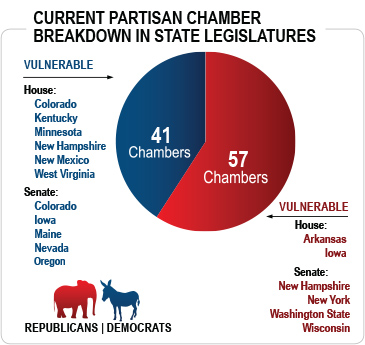
Graphic courtesy of National Council of State Legislatures
And Don’t Forget the Governors
On the executive side, 36 state governments have gubernatorial elections. 22 of these races are for offices currently held by Republican governors. For many of them, this is their first re-election bid since the Tea Party wave of 2010. 29 of these elections have an incumbent running for re-election.
Most research suggests that probably 9 of these races are potentials for partisan switch—Arizona (Jan Brewer—R, is retiring); Arkansan (Mike Beebe—D, is termed out); Connecticut (Dan Malloy—D, is running for re-election); Florida (Rick Scott—R, is running for re-election); Georgia (Nathan Deal—R, is running for re-election); Illinois (Pat Quinn—D, is running for re-election); Kansas (Sam Brownback—R, is running for re-election); Maine (Paul LePage—R, is running for re-election); Pennsylvania (Tom Corbett—R, is running for reelection). Keep an eye on these states, but be ready for surprise upsets in other places.
States to Watch
With 87 chambers holding elections, there is a lot of turmoil at the state level. Some of these races are incredibly close. For instance, the partisan control of Washington State’s Senate chamber is determined by just 1 person. In the Colorado and Nevada State Senates, party control is also determined by just one vote. In fact, there are 15 legislative bodies where the partisan control is currently determined by less than 10% of the total members. Voters this cycle have the potential to change the direction for a lot of state governments.
There are so many close races, but to narrow your focus, Ballotpedia compiled a Top 20 Elections to Watch.
- Arizona Senate (Republicans currently control 17-13)
- Arkansas House (Republicans control 51-48, 1 member is in the Green Party)
- Colorado Senate (Democrats control 18-17)
- Iowa Senate and House (Democrats control Senate 26-24; Republicans control House 53-47)
- Kentucky House (Democrats control 54-46)
- Maine Senate (Democrats control 19-15, 1 member is an independent)
- Michigan House (Republicans control 59-50, 1 member is an independent)
- Minnesota House (Democrats control 73-61)
- Nevada Senate (Democrats control 11-10)
- New Hampshire Senate and House (Republicans control Senate 12-11; Democrats control House 213-173)
- New Mexico House (Democrats control 37-33)
- New York Senate (Democrats control 32-29)
- Oregon Senate (Democrats control 16-14)
- Pennsylvania Senate and House (Republicans control Senate 27-23; Republicans control House 111-91)
- Washington Senate (Democrats control 25-24)
- West Virginia House (Democrats control 53-47)
- Wisconsin Senate (Republicans control 17-15)
Follow the Action
Which parties will gain control? What will our youth turnout look like after so much attention has been paid to Millennials? How many states will retain their partisanship? How many new voters may be denied voting because of new voting restrictions? I’ll be looking for these answers and more come Tuesday.
For real time updates on the 6,057 elections that will determine the partisan control of the 87 state chambers for the next two years, check out Ballotpedia’s State Legislative Elections 2014 page, which will be tracking results in real time.
For tracking polls on the U.S. Senate races, check out FiveThirtyEight.
If you want to find out the real deal of local coverage of state elections, check out this great list of state election results compiled by PhD student Kevin Collins.
Finally, watch for interesting updates on the elections and share your stories with us on Twitter with the #LaunchProgress hashtag.