
Monthly Archives: June 2014

Young Candidate Spotlight: Anna Diaz-Takes The Shield

by  · June 29, 2014 4:18 PM

Welcome to our ongoing interview series highlighting young elected officials and young candidates. This month we spoke with Anna Diaz-Takes The Shield, a 26-year-old Native American who is running for state representative of South Dakota’s 27th district.

Anna is also the County Commissioner for Shannon County, which represents District 2 in her hometown of Oglala, South Dakota. She ran for the office when she was 23 and is the youngest Native American woman in history to hold the office. Residing in one of the five South Dakota counties entirely on an Indian reservation, Anna is motivated to enter public service by a pressing commitment to the welfare of her people, a commitment that she hopes to expand to the rest of South Dakota’s 27th District. “We need to get our youth active and get them to step up for our elderly and for our people”, Anna says. “And I take that as a challenge.”

Anna brings a sense of focus to longstanding problems in the Native community. “Many of the most important issues stem from the reservation itself. Education, for one, is a huge factor. Certain things are not working,” Anna says. “With the No Child Left Behind Act, we’re still seeing children left behind, and it’s largely Native American children,” she continues. Access to quality healthcare is another problem. “It’s the Indian Health Service’s responsibility to preserve the health of the reservation, but, no matter where you’re from, it’s always a struggle to actually get [to the facilities].”

Anna tells us some of the biggest challenges she continues to face in the political process. “There were three main factors that kept coming up everywhere I went, the first one being that I’m a female,” she says. “The second one is being a Native American in politics,” she continues. “There’s always a bad light coming from people who don’t typically see Natives taking the time to try to further their community, whether it be from people who say that Natives are alcoholics, or the like.” But Native American political leadership is something that is very important to her. “It’s very difficult to explain the political struggles [of the tribes] to someone who is trying to represent you who is not from where you’re from.”

The third challenge, Anna says, is her age. She tells us about one of her experiences on the campaign trail for County Commissioner. “I went to a statewide convention meeting people, and I walked into a room of a hundred plus older white males, and they were all telling me, ‘You’re young. You don’t know what you’re doing. You need to go back to school.’”

All in all, Anna sees leadership by Millennials as very important. “There have been politicians who have been in office for years, and we have yet to see a change,” she said. “It’s time for young people to step up and become the leaders they are educating themselves to be.”
Investing in New American Leaders

by  · June 23, 2014 2:44 PM

Last week, I had the opportunity to speak at the New American Leaders Project Alumni Conference on supporting emerging political leaders.

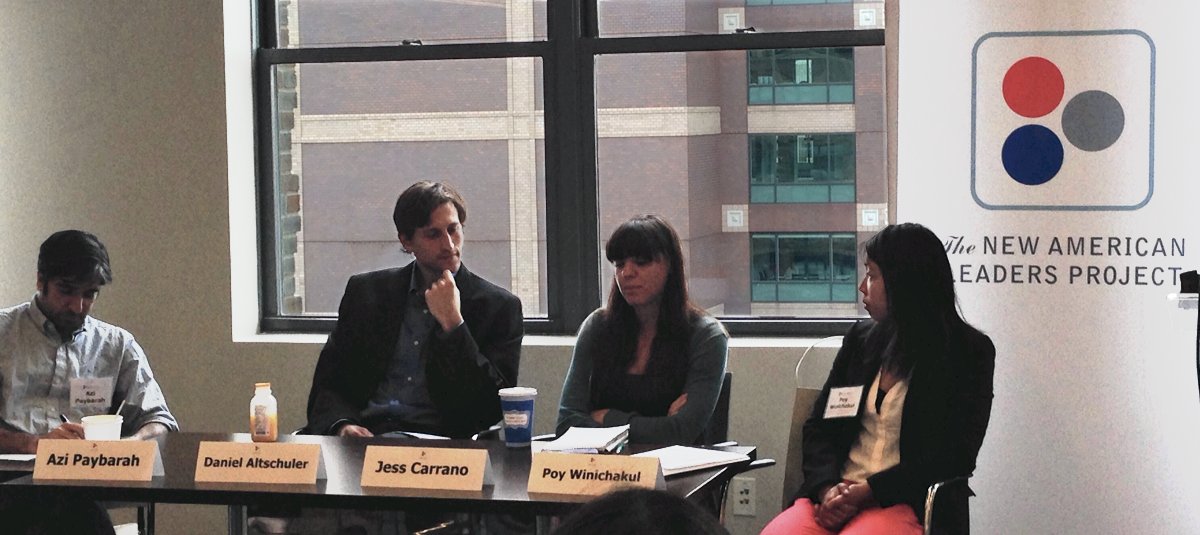
NALP panel

I joined Jess Carrano (Acting Political Director, Working Families Party), Dan Altschuler (Coordinator, Make the Road New York Action Fund), and Azi Paybarah (Reporter, Capital New York) in encouraging community leaders of color from across the country to run for office.

Young people are the most diverse generation in the country. Yet people of color are severely underrepresented in politics, making up only 16 percent of members of congress.

But we are all working to change this.

The Working Families Party in particular is an example of how an organization whose focus in long-term candidate investment can yield tremendous results. WFP, as Jess Carrano explained, works to support progressive candidates at the local level to influence state and even national politics. Their work, along with the work of allies, has created a sea change in New York City politics. They’ve helped grow the city council’s progressive caucus to 19 members this year. And, as Azi Paybarah acknowledged, WFP has become increasingly powerful in New York State politics, where they swayed Gov. Andrew Cuomo to adopt their platform and move further left on a number of issues, ranging from the New York DREAM Act to public financing of elections.

Dan Altschuler of Make the Road New York, whose sister organization works on immigration reform, noted there are significant opportunities to lift up candidates from areas where people don’t often try to run a progressive candidate, or a progressive candidate that doesn’t fit the usual “political mold.” His group, for instance, is working with progressive candidates on Long Island, whose elected officials and candidates are usually white and male.

And it’s not just organizations. Candidates have used state and local office as a place to generate more influence and jump-start their political careers. U.S. Reps. Yvette Clarke and Hakeem Jeffries, for example, both got their start in the New York City Council.

Just like these groups working in New York City, LaunchProgress is committed to supporting young progressives getting their start in politics. By working with candidates running for state and local office, LaunchProgress can build a new generation of leaders, who will run for higher office in the future.

We hope to echo the Working Families Party’s successes in also being able to move discussion around issues toward our progressive values. And like Make the Road New York, we focus on uplifting the voices of people from underrepresented backgrounds in politics. We value different perspectives in shaping our nation and only with those voices in the room can we move the country forward.

I am very humbled to have been on a panel with two fantastic progressive advocates. LaunchProgress is looking forward to working with groups like New American Leaders Project, the Working Families Party, and Make the Road New York to make sure our representatives better reflect our diverse America, starting at the local and state level.

National Journal’s The Next America: Elect a New Generation for Lasting Climate Change Solutions

by  · June 12, 2014 2:51 PM

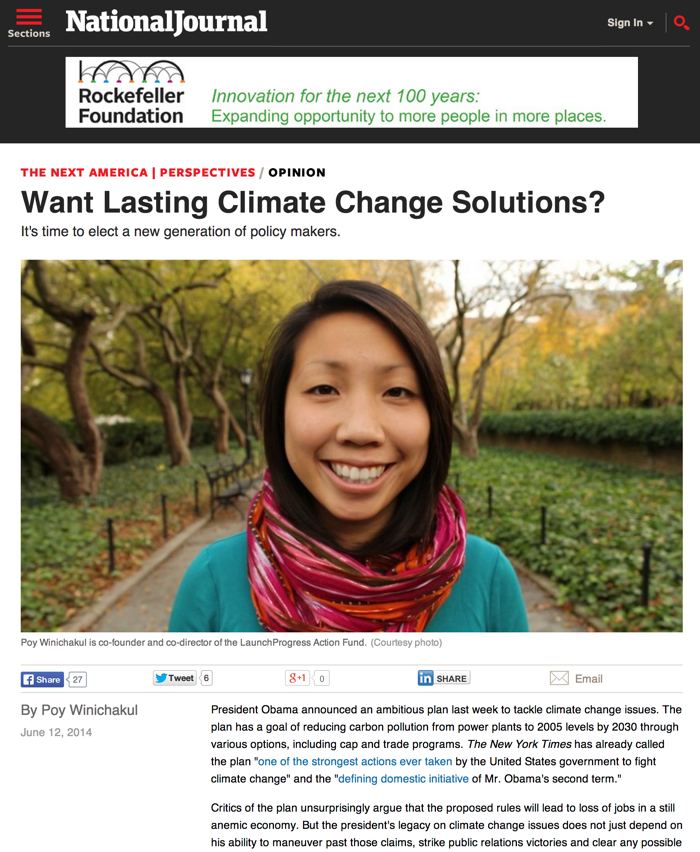
National Journal’s The Next America: Elect a New Generation for Lasting Climate Change SolutionsPresident Obama recently announced plans to cut power plant carbon pollution by 30%. But as LaunchProgress Co-Founder Poy Winichakul argues in National Journal’s The Next America series, this environmental victory needs to be expanded and defended by a new generation of policy makers:

If we want this plan to last, opportunities and answers lie with millennials. The president and the environmental community must do more to invest in this next generation of leaders, who will take up the mantle on climate change solutions.

Young voters care deeply about environmental issues but aren’t well represented in our legislatures:

In a recent poll by Harstad Strategic Research, 79 percent of millennials polled favor carbon pollution reductions to deal with climate change and global warming, compared to only 21 percent who opposed reductions. In a country where 82 percent of Hispanics and 89 percent of blacks support the regulation of carbon dioxide as a pollutant, and 70 percent of Asian-Americans consider themselves environmentalist, it’s not surprising that millennials—the largest and most diverse generation in America—support reducing carbon emissions.

While this progressive, problem-solving generation is ready to tackle climate change issues, we lack representation in our state houses and in Congress—only 8 percent of U.S. Representatives are under 40, compared to 53 percent of the country’s population. If the president wants progress on climate change, he must support young people running for public office.

Read Poy’s steps for eradicating the financial and structural obstacles young candidates face over at National Journal.

Want to learn more about Obama’s Clean Power Plan? The EPA posted a quick fact sheet.