Author Archives: admin

Young Candidate Spotlight: Michael Blake

by  · August 25, 2014 10:08 AM

Spotlight: Michael BlakeWelcome to our ongoing interview series highlighting young elected officials and young candidates.This month we spoke with 30-year-old Michael Blake, who is running for State Assemblyman in New York’s 79th assembly district, the district in which he was born and raised.

Michael is a seasoned political operative who has enjoyed tremendous success at the national level. He worked for Barack Obama from 2007 to 2013, first on his campaign, and then as an official in his administration. Serving as Deputy Political Director of the Iowa Caucus and National Deputy Director of Obama’s “Operation Vote,” Michael was instrumental in registering veterans, women, and communities of color to vote and turning them out to the polls. At the White House, he was Director of Minority Outreach at the Office of Public Engagement, implementing several initiatives all over the country, including the Urban Entrepreneurship Summit Series which helps promote urban start-ups and small businesses with a focus on inner-city entrepreneurship.

“But,” Michael says, “in the midst of all that, I kept coming home.”

With the high-stock he’s accumulated in national politics, we asked Michael why he would choose to run for State Assemblyman, a local office. “Why would I not be running for State Assembly?” he shot back, “This is a community that has impacted my family for three generations. I’ve had an opportunity to serve my country, and now there’s an opportunity to serve my community as well.”

Michael, whose district is situated in the heart of the Bronx, is seeking to become a representative of one of the most impoverished urban counties in the nation. When we asked him what were some of the most pressing issues in his district, he named many issues that plague inner cities across our nation. “Continual gun violence, continual joblessness, continual sense of hopelessness, continual lack of engagement in voting.”

It was then that Michael spoke to us about his effort to run a transformational campaign. “I am running for office because I want to bring positive change to the Bronx, and for people of the Bronx to see themselves in such a light where they expect and deserve great things,” he said.

“We need to increase community outreach, address the gun violence that is ravaging our community, focus on job training and on getting kids from the cradle to a career,” Michael said, “because if you help someone pick up a check and pick up a book, they don’t pick up a gun.”

We asked Michael to share his thoughts on the importance of millennial leadership in today’s political arena. “Millennial leadership isn’t just good. It’s necessary. We are the ones that provide energy, the impetus for change, and a different thought process,” he said.

Michael then told us about the effect millennial leadership could possibly have on kids from underprivileged backgrounds. “If we want young people to see what could be possible for them, we have to show them faces that they can relate to, and that will only occur through increased millennial leadership. They would see that they don’t have to be a gangbanger or a rapper,” he continued, “They would see they could be a doctor, or a lawyer. They could be President of a Fortune 500 company. They could be President of the United States.”

Finally, when we asked Michael if he had any words of wisdom to impart to others under 35 who were considering running for office, he left us with the words then-Senator Obama gave him in 2007, back when his ascent to the presidency seemed unlikely. The first thing Obama told Michael was, “Dream big dreams.”

Protect Voting

This month, a federal judge in North Carolina refused to block an egregious law that would make it harder to for young people to vote.

The law passed by the North Carolina State Legislature in 2012 cuts a program that promoted voter registration to high school students ahead of their 18th birthdays. It also cuts the early voting period and (starting in 2016) requires voters to present a government-issued photo ID. This makes voting difficult for college students, many of whom may not have a photo ID at all, or only have one with their home address, not the dorm or campus address where they are registered to vote.

This law is wrong. Unfortunately, North Carolina is not alone. Voting restrictions have spread across the country. Voter ID laws will go on trial next month in Arkansas, Texas, and Wisconsin. Ohio’s early voting cuts were in court last week. And new registration rules are on trial next week in Arizona and Kansas.

In 2012 over 22 million 18- to 29-year-olds cast a ballot. We should be encouraging even more young people to get involved in making decisions for the future of our country — not making it harder for them to vote.

That’s why we are proud to join Rock the Vote and more than 50 allies in standing up against unfair laws, like the one in North Carolina, that disproportionately affect our ability to participate in our democracy. If you think it’s important to keep our elections free, fair, and accessible, make sure you sign this petition today.Protect Voting

Why Pundits Miss the Point on Millennials

by  · August 11, 2014 6:00 AM

Attempts by the media to define the millennial generation abound. Sensationalist pieces on our social habits, buying tendencies, mannerisms, self-view, world-view, and perhaps most frequently, political leanings, crop up daily. The eagerness to pin down our generation’s preferences is unsurprising, given we will soon hold political and economic power, inheriting a slew of deep-seeded problems in almost every arena.

So what’s the story? The “experts” can’t seem to agree, even with themselves.

David Leonhardt of The New York Times wrote a piece explaining “Why Teenagers Today May Grow Up Conservative.” Events occurring as a generation gains political consciousness forms its political identity, he argued. For teens, largely too young to remember Bush, this means problems under the Obama administration could negatively affect their view of the Democratic Party well into the future. While acknowledging that millennials are overwhelmingly liberal on social issues like same-sex marriage, he noted there could be some residual backlash against Democrats for current government dysfunction.

However, just a week later he wrote, “Politically, 18-Year-Olds Look a Lot Like People in Their 20s,” noting that, while Democrats may be in trouble on some issues or among certain populations, they still have a 14-15 point advantage with young people over Republicans. New York Magazine’s Jonathan Chait agreed with this “emerging democratic majority” theory. Because the electorate is increasingly diverse and individuals of minority backgrounds tend to be overwhelmingly liberal, he wrote, millennials will consistently skew to the left.

Ana Marie Cox of the Guardian dubbed the average millennial a “Somewhat Concerned Multicultural Moderate” — that is, an individual who supports socially liberal policies and is less concerned with fiscal issues. Citing data from a Reason survey, she noted that millennials are far less likely than their elders to identify with a particular political party, but are definitely averse to the outrage style of socially conservative discourse set forth by Republicans.

Anand Giridharadas offered a variant of this argument in The New York Times by painting a portrait of millennials that favors a “live and let live” philosophy. Millennials are individualists who have little faith in the power of government to solve collective problems, he wrote. And considering the failed war on drugs, two unsuccessful conflicts in the Middle East, the Great Recession, the end of NASA’s space shuttle program, and Washington gridlock, Giridharadas conceded, “this is a generation of American young people who may be rightly suspicious of grand collective enterprises.”

While pundits struggle to find a theory that sticks — pouring over data to find a millennial portrait that coheres to our current political framework — it seems many are missing the point. The data doesn’t indicate millennials’ views are “incoherent,” or we have given up on the power of collective action in the political sphere. But it does show we are dissatisfied with the current system. Our political leadership is older and less diverse than the electorate. It is unsurprising that young people’s views do not subscribe to the categories set forth by those currently in power.

Furthermore, our current political leadership has systematically created many of the crises facing the millennial generation through their political games, staking the future of the country on partisan gain. From a rapidly deteriorating environment to untenable economic inequality, there are a plenitude of problems that demand innovative solutions. Yet it is clear that real innovation is unwelcome by established leadership. Regardless of our political leanings, young people care. Millennials want to feel like the sky isn’t falling all the time, like progress can be made on these issues, and the world can support a more just, sustainable future.

This is where the work of LaunchProgress comes in. By assisting young, progressive candidates with forward-thinking policy views, we can begin to elect a new generation of leaders who will change the political debate, starting at the local level and expanding upward. This generation has the power to invigorate government. LaunchProgress candidates believe in the ability of the political process to bring people together toward socially just goals, navigating the country out of infuriating gridlock.

We would welcome fewer articles about millennials’ views on the status quo, and more about millennial leaders looking to change it.

Clara Potter is Communications Coordinator at LaunchProgress.

Why I Started My Own Political Action Committee For Millennials

by  · August 08, 2014 4:58 PM

As featured on Literally, Darling on August 5, 2014.


There have been a lot of articles lately about idle young people not caring and about single women not voting. I’m a 25-year-old unmarried woman and I started a nonprofit and a political action committee to encourage and support young people running for office. I definitely care. I definitely vote.

But I wasn’t always this way. Growing up, I was as apolitical as they come. I refused to watch the news. I tuned out protests. Until senior year of high school, I picked up a newspaper only to reuse as gift-wrap. My family is from Thailand, and while I’ve lived in America nearly all of my life, American politics often felt irrelevant to me—politicians didn’t look like me, they didn’t talk like me, they didn’t seem to live like me. Nor did I feel connected to what was happening in Thailand. I was living in between nationalities, in between two experiences. It was complicated, and, like a good teenager, I chose to tune it all out.

That changed when I went to college. In September 2008, I was at a liberal arts school in Ohio, located in one of the country’s most impoverished counties. At the time, one in four homes was foreclosed.

I walked past those empty homes every day on the way to my economics class where we were learning theory and discussing America’s financial future. As part of a research project that year, I delved into housing and loans, but also talked to homeowners in the community who were given a bad deal—often the now-infamous racially targeted, subprime loans—and were about to lose their homes because they couldn’t get out of a mortgage that was impossible to pay off in the first place. It didn’t seem right that in a country founded on the right to pursue opportunities—the country my family immigrated to in pursuit of opportunities—that some should have them and some should not.

Yet here I was, standing on a mound of knowledge with access to the resources of an elite institution and living in a community where residents were drowning in indecipherable legal documents with nowhere to turn for help.

I again was in between two worlds.

But this time I didn’t ignore being in the middle. I used it. That year, I started a small organization, a coalition of community leaders to connect homeowners to the resources they needed to stay in their homes. We filled the gap.

It’s been a long time since that experience, but I now run a nonprofit and a political action committee with that same mentality. LaunchProgress encourages and supports young people running for state and local office, focusing on uplifting voices from underrepresented backgrounds. We are filling the gaps in our political system with people who usually fall through the cracks—LGBTQ people, women, people of color.

We believe people who fall in between worlds are powerful because our experiences cover a multitude of overlapping aspects of life. At LaunchProgress, we think those perspectives need to be heard. And we encourage those voices to lead.

We especially focus on young people because they fill a unique void. The millennial generation is solution-oriented, innovative, and empowered by unprecedented technological advances. Our country desperately seeks change and we are equipped to lead that change.

I’m lucky to work with amazing young people who are leading that change every day. Our candidates and supporters are black, white, Asian, LGBTQ, women. They are in urban areas, in rural areas, in suburbs. They come from public school educations and from low-income backgrounds. But they all have powerful stories about how they came to public service and how their experiences have led them to run for office. They are full of energy, passion, and ideas to move their communities forward.

When the media began highlighting millennials and unmarried single women as the biggest question marks in voter turnout this year, I felt a certain call to arms. Young women—we are powerful. Our experiences holding multiple roles—as sisters, daughters, listeners, thinkers, mitigators, leaders, multitaskers—are valuable. Our opinions make the difference. We should feel empowered to make that difference by speaking, by voting, by running for office and leading.

Whether you follow politics, work for politics, or don’t care for it—we need you to vote. We need you to run. We need you to lead. We need your perspective and your voice to be heard to move the country forward. You make all the difference.

Poy Winichakul is the co-founder and co-director of LaunchProgress, a nonprofit and a political action committee working to encourage and support young progressives running for state and local office. 

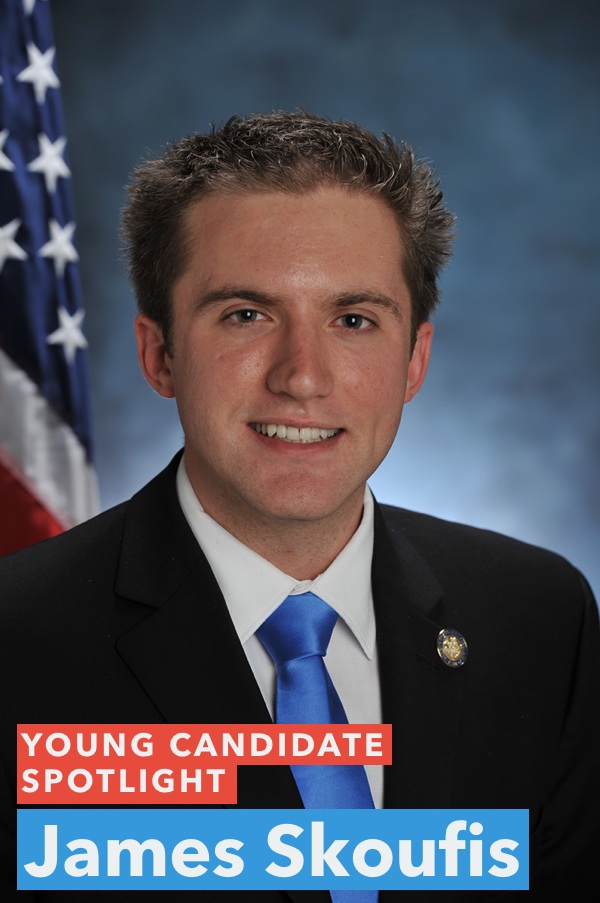
Young Candidate Spotlight: James Skoufis

by  · July 29, 2014 10:38 AM

Spotlight: James SkoufisWelcome to our ongoing interview series highlighting young elected officials and young candidates. This month we spoke with 26-year-old, state assemblyman James Skoufis.

James represents New York State’s 99th assembly district, which includes his hometown of Woodbury. Motivated by a sense of duty to the community that he grew up in and by his desire to do good and help people, James first entered public service when he was just 22, serving on the Woodbury Town Council and was elected to the state assembly two years later when he was 25.
It has often been said that millennials are ill-suited for leadership because of their age and because they care only about issues that affect their generation and nothing else. James, however, defies those stereotypes. Telling us that initially his biggest obstacle was proving himself to others who believed him to be incapable because of his age, James has demonstrated a unique kind of leadership millennials can bring to the table—the kind of innovative and comprehensive leadership it takes for the job. “Age is just a number whether you’re 25, 45, or 65. Either you know the stuff—or you don’t. Either you do the job—or you don’t,” he says.

James then gave us a glimpse of some of the issues in his district. “Access to quality education and access to healthcare are important issues,” he told us. “In light of increasing class sizes, layoffs, and program cuts, I’ve successfully fought for substantial state funding increases to my district’s K-12 schools.” Furthermore, James introduced legislation earlier this year to make New York’s public colleges tuition free. The catch? The student would only be required to perform community service while attending. “Anyone that wants to better educate him or herself should be able to do so regardless of how much money their family makes, where they come from, their race, their ethnicity or their background,”James said.

James has also worked to ensure services to for his older constituencies as well. “My district’s families and seniors are also concerned with their local health care options,” he says. “For example, some in Orange County continue to push for the privatization of Valley View Nursing Home, a proposition I have been a vocal opponent of due to concerns over quality and access of care as well as jobs.”

He goes on to tell us of his opposition to a local hospital in his district that petitioned the state last year to transition their emergency room to part-time status. “You can’t time a car accident or heart attack which is why I led the opposition to the hospital’s application,” James says. Because of legislation he passed in the Assembly, the part-time application was dropped and the ER remains open full-time to this day.

We pivoted and asked James for his thoughts on how to leadership. He suggested a bottom-up approach—starting at the most basic levels of civic engagement—to fostering millennial leadership, having observed some disturbing trends he believes need fixing when it comes to young people and our political system. “Far too many civic organizations I’ve visited with don’t have a single young man or woman as a member; there is often no youth presence at local board meetings,” he said, “And, as we all know, those in their late teens and 20s are far less likely to vote compared to their parents and grandparents.”

James left us an additional word to wisdom to give to those of us looking to motivate more young progressives to get more involved in their government. “I don’t believe there is any easy or simple way” he remarked. “It starts, however, by restoring faith in people’s minds that government can be a force of good, not just a force of gridlock, and that, should they choose to get involved, they will truly have an opportunity to be able to make a meaningful difference—not spin their wheels or waste their time.”

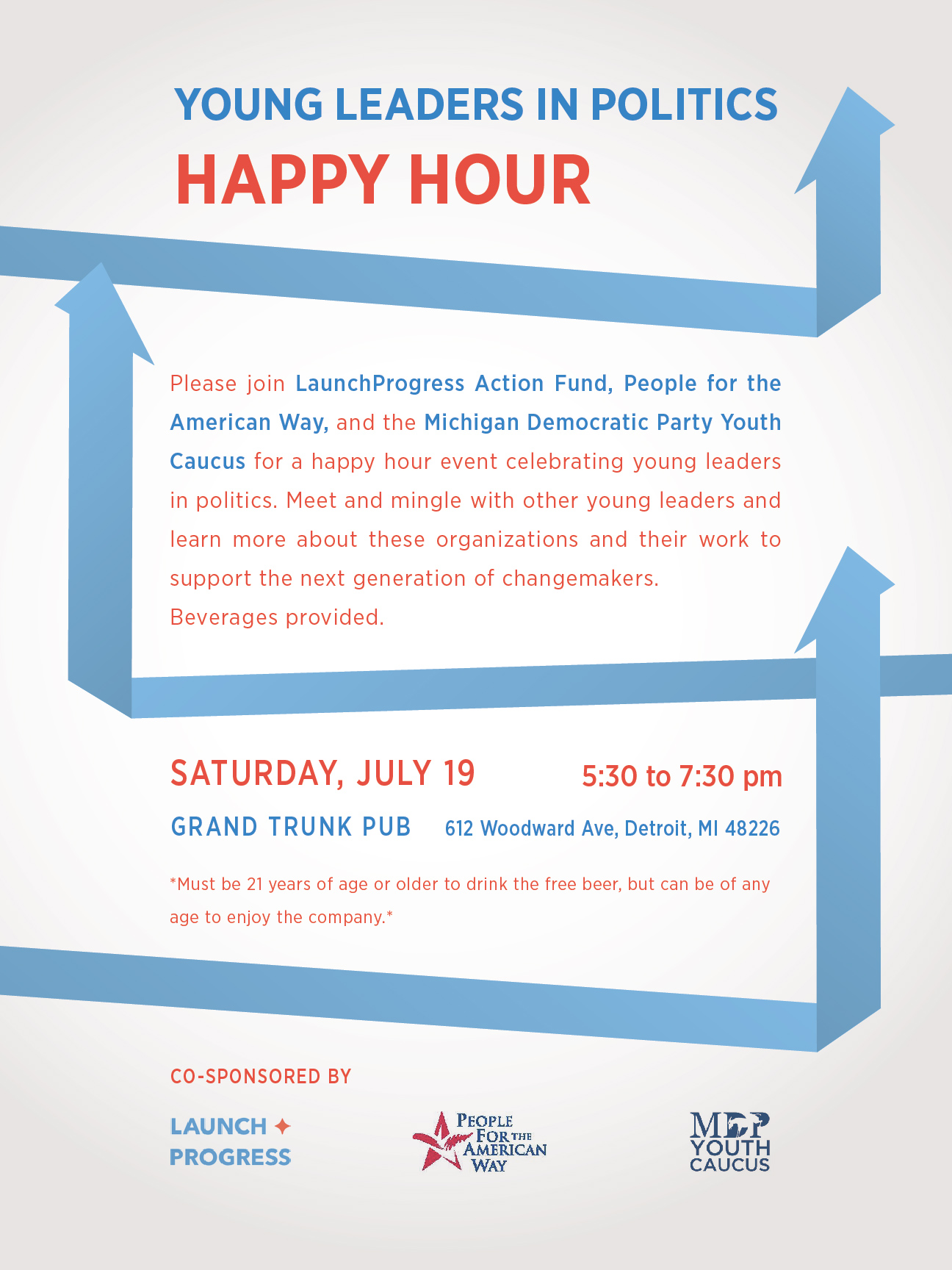
Young Leaders in Politics Happy Hour at Netroots Nation

by  · July 14, 2014 10:53 AM

Please join LaunchProgress Action Fund, People for the American Way, and the Michigan Democratic Party Youth Caucus for a happy hour event celebrating young leaders in politics. Meet and mingle with other young leaders and learn more about these organizations and their work to support the next generation of changemakers. Beverages provided.*

Saturday, July 19
5:30-7:30
Grand Trunk Pub
612 Woodward Avenue, Detroit, MI 48226Young Leaders Happy Hour

*Must be over 21 years of age to drink the free beer, but can be of any age to enjoy the company!

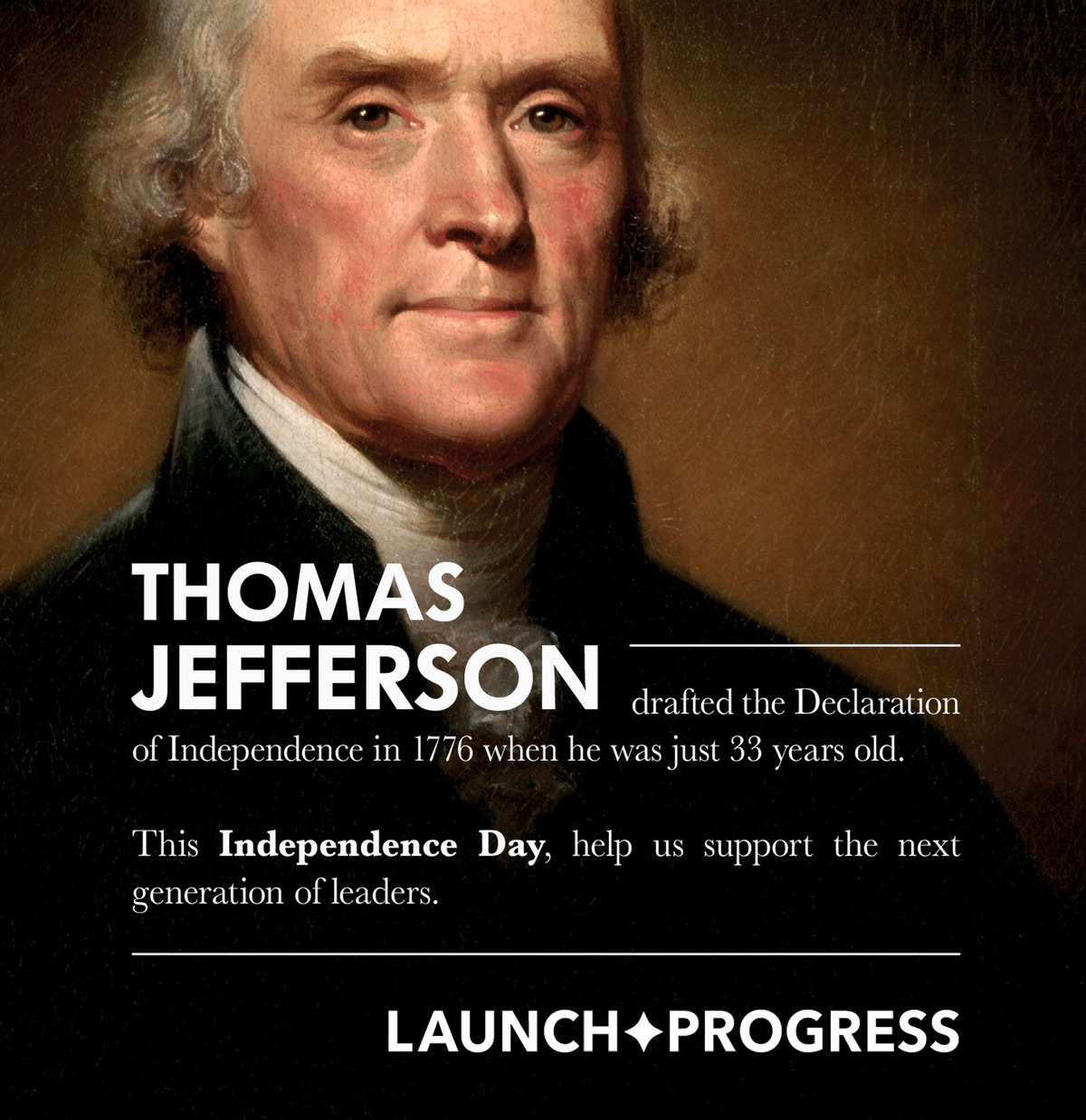
HuffPost: Young People Helped Found This Country, It’s Time for Us to Step Up and Lead Again

by  · July 02, 2014 9:52 PM

The Huffington Post published an op-ed by Stevaughn Bush, Communications Coordinator at LaunchProgress. Stevaughn highlights the obstacles younger candidates face—proving their abilities, raising sufficient funds to compete against entrenched interests, and overcoming gender and racial bias that still exist in our country. As we celebrate the 238th anniversary of a fundamental change in our nation’s politics, LaunchProgress is working to help with the next:

This is what LaunchProgress is trying to change. Our plan is to build a new infrastructure that will help millennials of all backgrounds jump into politics. This will create a new generation of progressive leaders — leaders who look like our changing America and govern with our interests in mind.

In 1776, young people were instrumental in helping form our new nation, founded on the principles of equality and opportunity for all. America has been trying to live up to that founding principle ever since. By investing in the next generation of progressive policymakers, we can help create the kind of open, diverse, and prosperous nation our Founders would be proud of.

Read the full op-ed over at the Huffington Post.LaunchProgress Thomas Jefferson

Young Candidate Spotlight: Anna Diaz-Takes The Shield

by  · June 29, 2014 4:18 PM

Welcome to our ongoing interview series highlighting young elected officials and young candidates. This month we spoke with Anna Diaz-Takes The Shield, a 26-year-old Native American who is running for state representative of South Dakota’s 27th district.

Anna is also the County Commissioner for Shannon County, which represents District 2 in her hometown of Oglala, South Dakota. She ran for the office when she was 23 and is the youngest Native American woman in history to hold the office. Residing in one of the five South Dakota counties entirely on an Indian reservation, Anna is motivated to enter public service by a pressing commitment to the welfare of her people, a commitment that she hopes to expand to the rest of South Dakota’s 27th District. “We need to get our youth active and get them to step up for our elderly and for our people”, Anna says. “And I take that as a challenge.”

Anna brings a sense of focus to longstanding problems in the Native community. “Many of the most important issues stem from the reservation itself. Education, for one, is a huge factor. Certain things are not working,” Anna says. “With the No Child Left Behind Act, we’re still seeing children left behind, and it’s largely Native American children,” she continues. Access to quality healthcare is another problem. “It’s the Indian Health Service’s responsibility to preserve the health of the reservation, but, no matter where you’re from, it’s always a struggle to actually get [to the facilities].”

Anna tells us some of the biggest challenges she continues to face in the political process. “There were three main factors that kept coming up everywhere I went, the first one being that I’m a female,” she says. “The second one is being a Native American in politics,” she continues. “There’s always a bad light coming from people who don’t typically see Natives taking the time to try to further their community, whether it be from people who say that Natives are alcoholics, or the like.” But Native American political leadership is something that is very important to her. “It’s very difficult to explain the political struggles [of the tribes] to someone who is trying to represent you who is not from where you’re from.”

The third challenge, Anna says, is her age. She tells us about one of her experiences on the campaign trail for County Commissioner. “I went to a statewide convention meeting people, and I walked into a room of a hundred plus older white males, and they were all telling me, ‘You’re young. You don’t know what you’re doing. You need to go back to school.’”

All in all, Anna sees leadership by Millennials as very important. “There have been politicians who have been in office for years, and we have yet to see a change,” she said. “It’s time for young people to step up and become the leaders they are educating themselves to be.”

Investing in New American Leaders

by  · June 23, 2014 2:44 PM

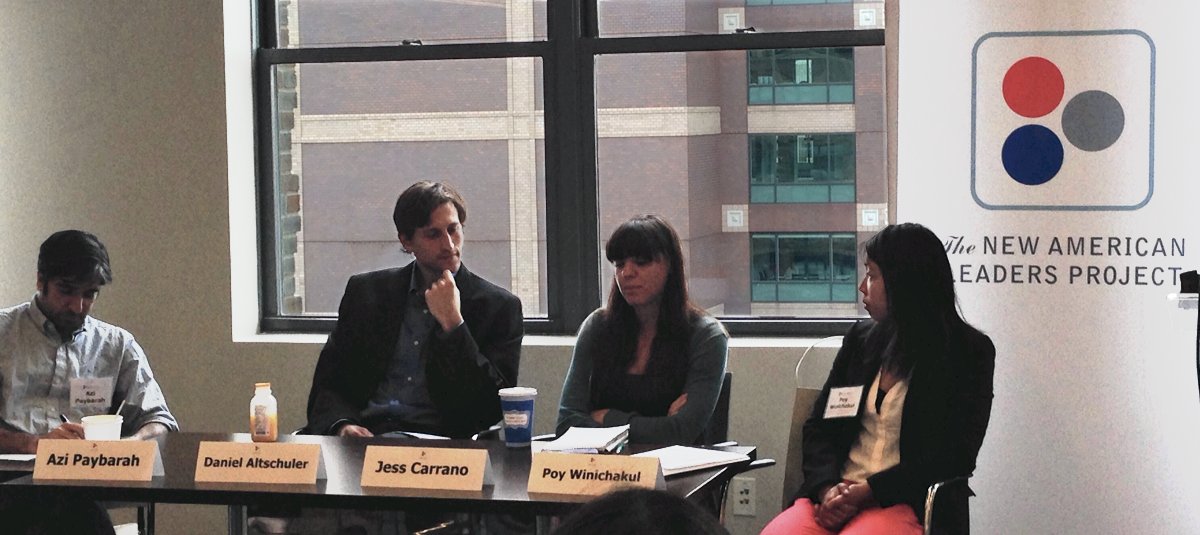
Last week, I had the opportunity to speak at the New American Leaders Project Alumni Conference on supporting emerging political leaders.

NALP panel

I joined Jess Carrano (Acting Political Director, Working Families Party), Dan Altschuler (Coordinator, Make the Road New York Action Fund), and Azi Paybarah (Reporter, Capital New York) in encouraging community leaders of color from across the country to run for office.

Young people are the most diverse generation in the country. Yet people of color are severely underrepresented in politics, making up only 16 percent of members of congress.

But we are all working to change this.

The Working Families Party in particular is an example of how an organization whose focus in long-term candidate investment can yield tremendous results. WFP, as Jess Carrano explained, works to support progressive candidates at the local level to influence state and even national politics. Their work, along with the work of allies, has created a sea change in New York City politics. They’ve helped grow the city council’s progressive caucus to 19 members this year. And, as Azi Paybarah acknowledged, WFP has become increasingly powerful in New York State politics, where they swayed Gov. Andrew Cuomo to adopt their platform and move further left on a number of issues, ranging from the New York DREAM Act to public financing of elections.

Dan Altschuler of Make the Road New York, whose sister organization works on immigration reform, noted there are significant opportunities to lift up candidates from areas where people don’t often try to run a progressive candidate, or a progressive candidate that doesn’t fit the usual “political mold.” His group, for instance, is working with progressive candidates on Long Island, whose elected officials and candidates are usually white and male.

And it’s not just organizations. Candidates have used state and local office as a place to generate more influence and jump-start their political careers. U.S. Reps. Yvette Clarke and Hakeem Jeffries, for example, both got their start in the New York City Council.

Just like these groups working in New York City, LaunchProgress is committed to supporting young progressives getting their start in politics. By working with candidates running for state and local office, LaunchProgress can build a new generation of leaders, who will run for higher office in the future.

We hope to echo the Working Families Party’s successes in also being able to move discussion around issues toward our progressive values. And like Make the Road New York, we focus on uplifting the voices of people from underrepresented backgrounds in politics. We value different perspectives in shaping our nation and only with those voices in the room can we move the country forward.

I am very humbled to have been on a panel with two fantastic progressive advocates. LaunchProgress is looking forward to working with groups like New American Leaders Project, the Working Families Party, and Make the Road New York to make sure our representatives better reflect our diverse America, starting at the local and state level.

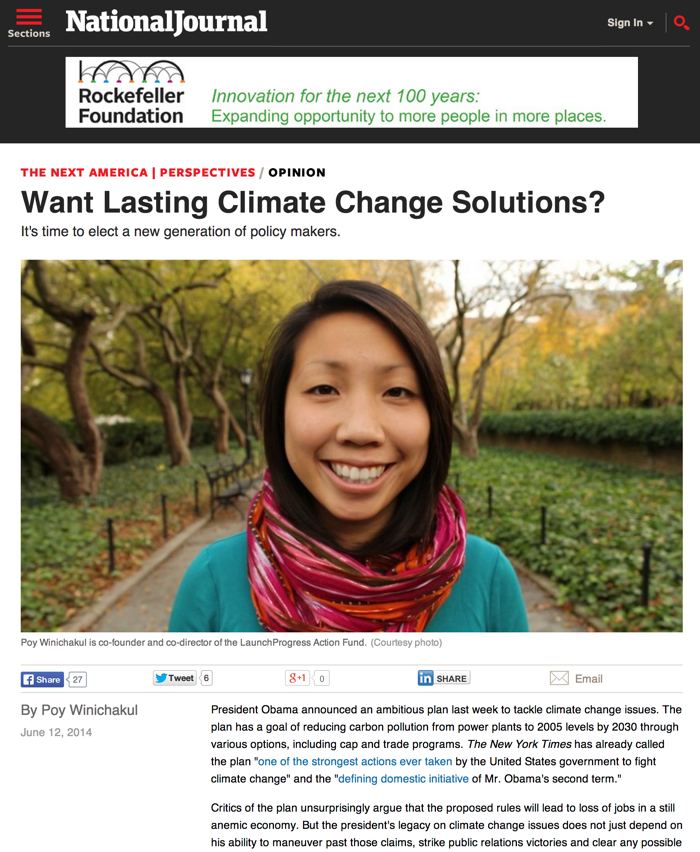
National Journal’s The Next America: Elect a New Generation for Lasting Climate Change Solutions

by  · June 12, 2014 2:51 PM

National Journal’s The Next America: Elect a New Generation for Lasting Climate Change SolutionsPresident Obama recently announced plans to cut power plant carbon pollution by 30%. But as LaunchProgress Co-Founder Poy Winichakul argues in National Journal’s The Next America series, this environmental victory needs to be expanded and defended by a new generation of policy makers:

If we want this plan to last, opportunities and answers lie with millennials. The president and the environmental community must do more to invest in this next generation of leaders, who will take up the mantle on climate change solutions.

Young voters care deeply about environmental issues but aren’t well represented in our legislatures:

In a recent poll by Harstad Strategic Research, 79 percent of millennials polled favor carbon pollution reductions to deal with climate change and global warming, compared to only 21 percent who opposed reductions. In a country where 82 percent of Hispanics and 89 percent of blacks support the regulation of carbon dioxide as a pollutant, and 70 percent of Asian-Americans consider themselves environmentalist, it’s not surprising that millennials—the largest and most diverse generation in America—support reducing carbon emissions.

While this progressive, problem-solving generation is ready to tackle climate change issues, we lack representation in our state houses and in Congress—only 8 percent of U.S. Representatives are under 40, compared to 53 percent of the country’s population. If the president wants progress on climate change, he must support young people running for public office.

Read Poy’s steps for eradicating the financial and structural obstacles young candidates face over at National Journal.

Want to learn more about Obama’s Clean Power Plan? The EPA posted a quick fact sheet.