
by Stevaughn Bush · July 29, 2014 10:38 AM
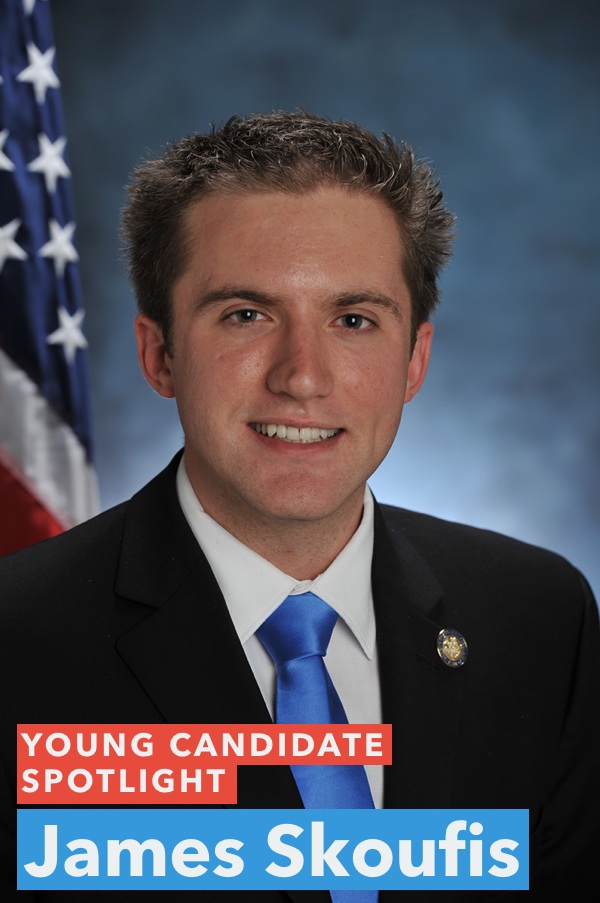 Welcome to our ongoing interview series highlighting young elected officials and young candidates. This month we spoke with 26-year-old, state assemblyman James Skoufis.
James represents New York State’s 99th assembly district, which includes his hometown of Woodbury. Motivated by a sense of duty to the community that he grew up in and by his desire to do good and help people, James first entered public service when he was just 22, serving on the Woodbury Town Council and was elected to the state assembly two years later when he was 25.
It has often been said that millennials are ill-suited for leadership because of their age and because they care only about issues that affect their generation and nothing else. James, however, defies those stereotypes. Telling us that initially his biggest obstacle was proving himself to others who believed him to be incapable because of his age, James has demonstrated a unique kind of leadership millennials can bring to the table—the kind of innovative and comprehensive leadership it takes for the job. “Age is just a number whether you’re 25, 45, or 65. Either you know the stuff—or you don’t. Either you do the job—or you don’t,” he says.
James then gave us a glimpse of some of the issues in his district. “Access to quality education and access to healthcare are important issues,” he told us. “In light of increasing class sizes, layoffs, and program cuts, I’ve successfully fought for substantial state funding increases to my district’s K-12 schools.” Furthermore, James introduced legislation earlier this year to make New York’s public colleges tuition free. The catch? The student would only be required to perform community service while attending. “Anyone that wants to better educate him or herself should be able to do so regardless of how much money their family makes, where they come from, their race, their ethnicity or their background,”James said.
James has also worked to ensure services to for his older constituencies as well. “My district’s families and seniors are also concerned with their local health care options,” he says. “For example, some in Orange County continue to push for the privatization of Valley View Nursing Home, a proposition I have been a vocal opponent of due to concerns over quality and access of care as well as jobs.”
He goes on to tell us of his opposition to a local hospital in his district that petitioned the state last year to transition their emergency room to part-time status. “You can’t time a car accident or heart attack which is why I led the opposition to the hospital’s application,” James says. Because of legislation he passed in the Assembly, the part-time application was dropped and the ER remains open full-time to this day.
We pivoted and asked James for his thoughts on how to leadership. He suggested a bottom-up approach—starting at the most basic levels of civic engagement—to fostering millennial leadership, having observed some disturbing trends he believes need fixing when it comes to young people and our political system. “Far too many civic organizations I’ve visited with don’t have a single young man or woman as a member; there is often no youth presence at local board meetings,” he said, “And, as we all know, those in their late teens and 20s are far less likely to vote compared to their parents and grandparents.”
James left us an additional word to wisdom to give to those of us looking to motivate more young progressives to get more involved in their government. “I don’t believe there is any easy or simple way” he remarked. “It starts, however, by restoring faith in people’s minds that government can be a force of good, not just a force of gridlock, and that, should they choose to get involved, they will truly have an opportunity to be able to make a meaningful difference—not spin their wheels or waste their time.”